
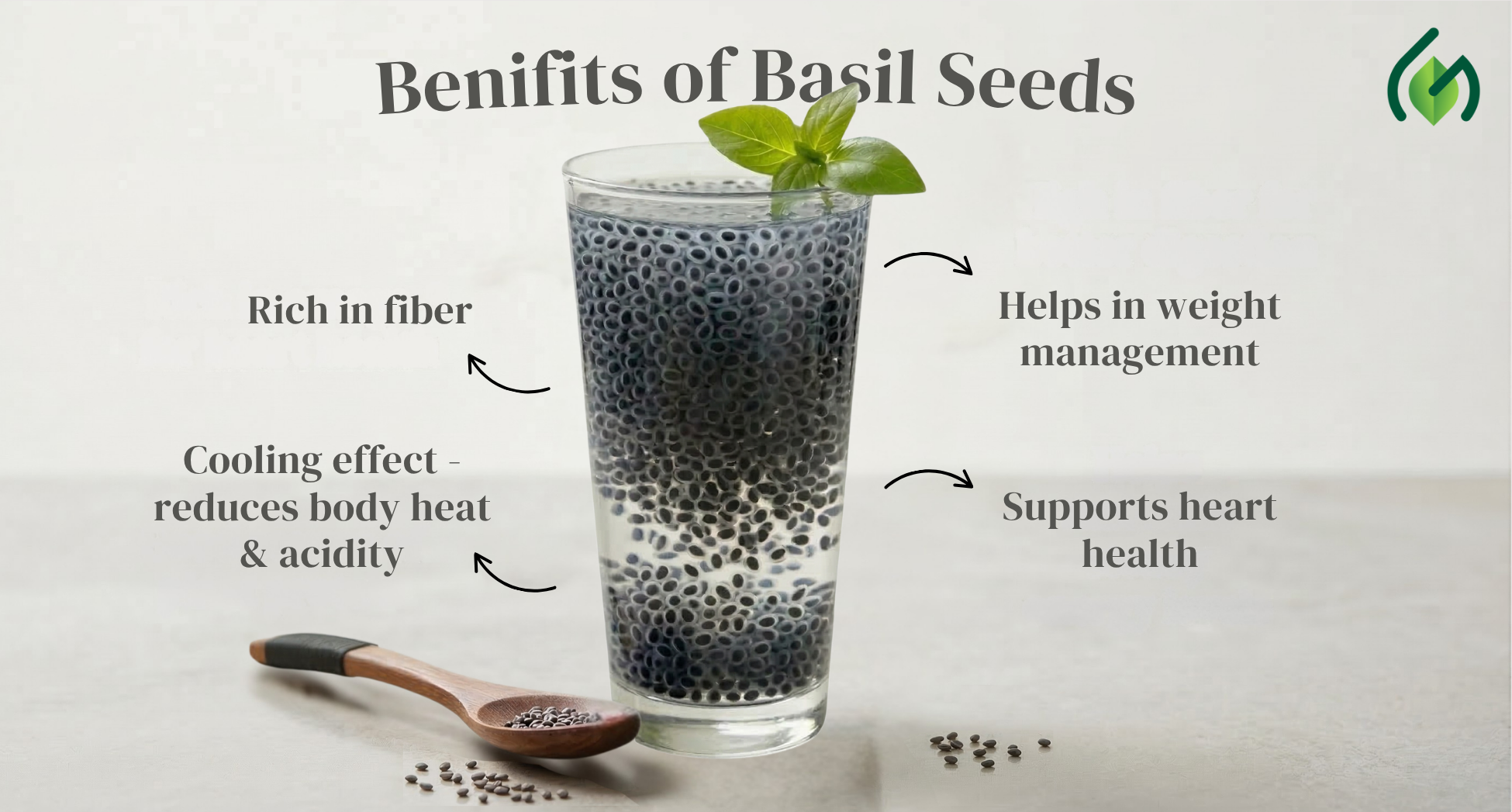
Basil Seeds have been used across South Asia and the Middle East for centuries, most commonly in drinks, desserts, and traditional remedies. What has changed recently is their arrival in mainstream functional food and beverage formulations across the US and Europe. Food manufacturers, supplement brands, and RTD developers are all picking them up for the same reason: one ingredient that delivers multiple meaningful benefits, with a clean label declaration consumers have no reason to question.
This post covers the key benefits of basil seeds and why they are worth serious consideration for your next formulation or sourcing decision.
#1: Fast gel formation for beverage manufacturing
The most commercially significant property of basil seeds is how quickly they hydrate. Drop them into liquid and within two to three minutes each seed is surrounded by a thick, stable, translucent gel. The seed itself stays intact inside, giving beverages a distinctive visual texture that consumers find appealing.
Unlike chia seeds, which can take up to twenty minutes to fully hydrate, basil seeds are production-ready almost immediately. No heat activation, no pre-soaking step in the manufacturing line, and no additional stabilizers needed to maintain texture through shelf life. That simplicity reduces both formulation complexity and production cost. The flavour contribution is virtually zero, meaning the seeds take on the taste of whatever liquid they are soaked in and give formulators complete freedom over the finished product ready to serve.
#2: High soluble fiber for digestive health
Basil seeds are one of the most concentrated natural sources of dietary fiber available as zero to minimal processed ingredient. The majority of that fiber is soluble, which means it absorbs water and forms a gel in the digestive tract rather than passing through undigested. The practical effects are well supported, as noted down below:
- – Slow gastric emptying and extends the feeling of fullness after eating.
- – Acts as a prebiotic, feeding beneficial gut bacteria and supporting microbiome health.
- – Helps regulate bowel movement frequency and consistency.
- – Contributes to reduced LDL cholesterol with regular consumption.
For supplement brands and functional food manufacturers, this makes basil seeds a genuinely useful ingredient for digestive health and gut support, with claims that can be substantiated directly through the fiber content declaration on the label.
#3: Blood sugar regulation and metabolic health
The soluble fibre in basil seeds slows the absorption of carbohydrates in the digestive tract, which reduces the rate at which glucose enters the bloodstream after a meal. This glycaemic-modulating effect is one of the more clinically relevant properties of the ingredient and is increasingly referenced in diabetes management and metabolic health positioning.
The effect is partly mechanical – the gel formed in the gut physically slows digestion – and partly nutritional, since basil seeds also contain compounds that may influence glucose metabolism directly. For brands operating in the blood sugar support or diabetes wellness space, this is a credible and growing evidence base to build product claims around.
#4: Plant-based Omega-3, iron, and calcium
Beyond fiber, basil seeds deliver a nutritional profile that gives formulators additional label claim options without a complex ingredient stack:
- – Omega-3 fatty acids: A source of alpha-linolenic acid (ALA), supporting brain health and cardiovascular function positioning.
- – Iron: Relevant for energy support and immune function claims, particularly in products targeting women and active consumers.
- – Calcium: Supports bone health claims and is especially valuable in dairy-free and plant-based formulations where calcium delivery is otherwise challenging.
- – Antioxidants: Flavonoids and polyphenols that support general wellness and anti-inflammatory positioning.
This combination in a single ingredient is unusual. Most natural ingredients contribute nothing to the nutritional panel. Basil seeds open up multiple claim angles from one product.
#5: Basil seeds help in weight management
When basil seeds hydrate in the stomach they expand significantly, creating a physical sensation of fullness that reduces appetite and overall calorie intake. Combined with their negligible calorie contribution, this makes them one of the more practical natural ingredients for weight management formulations.
A basil seed beverage consumed before or with a meal may reduce hunger, which is a benefit consumers understand intuitively without needing to read the science. The gel texture is also visually associated with substance and nourishment in a way that clear liquid drinks are not, which reinforces the feeling of fullness at a sensory level. RTD brands, meal replacement developers, and functional snack manufacturers are all applying this effectively.
#6: Clean Label, Naturally Vegan
Basil seeds are a seed, not an extract, an isolate, or a modified starch. Consumers understand what they are reading on the label and do not read it as an additive. In markets where clean label positioning drives purchasing decisions – which now includes most developed food retail channels – that simplicity removes several common barriers to market entry at once.
Sourcing bulk Indian Basil seeds? Let’s do it right.
Lineark Global operates as a Supplier, manufacturer-exporter with robust sourcing, cleaning, testing, and your compliance partner.
We offer CIF pricing to your nearest port, backed by clearly defined grade specifications, we also offer IPM Quality lot-wise lab reports, and timely container scheduling.
Email: sales@linearkglobal.com | WhatsApp: +91 7990849566
0 Comments