
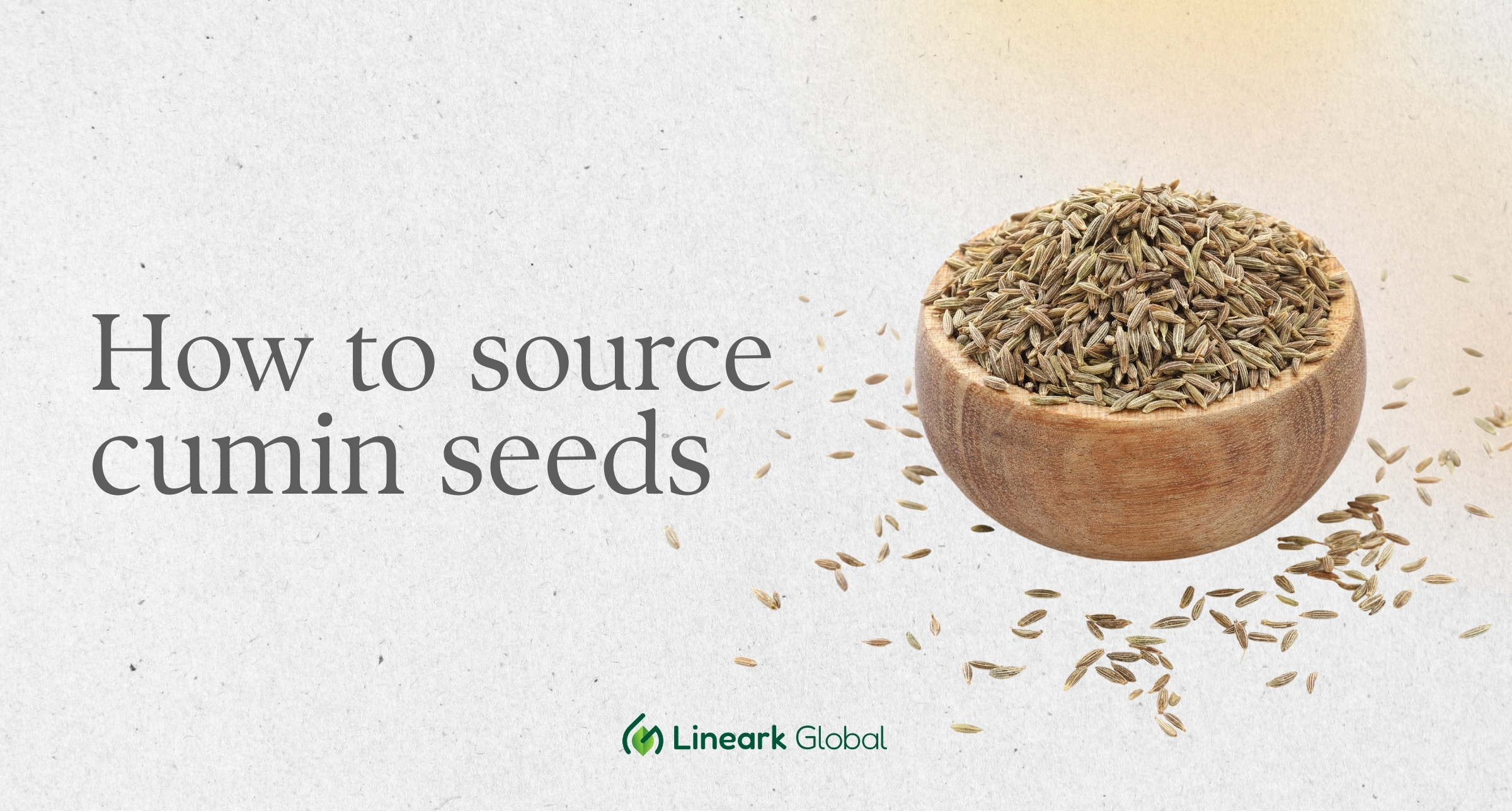
For procurement teams buying Indian Cumin Seeds in bulk, the problem has never been finding a supplier. It has always been finding consistency. Cumin looks uniform in a sample bag. It rarely behaves that way across 20 ft. containers. The differences show up in grinding yield, aroma strength, lab reports, and regulatory checks at destination ports. At Lineark Global, we built our entire sourcing model around eliminating that gap by sourcing from IPM-compliant farmers to export documentation till delivery at destination port.
#1: Where quality actually begins!
Most export-grade Indian cumin originates from the semi-arid growing belts of Gujarat and Rajasthan, with Unjha serving as the primary global pricing benchmark. But “India origin” is not a quality guarantee on its own. Real quality is determined much earlier at the raw lot selection stage, during aggregation, and through the processing choices made before a single seed reaches the cleaning floor.
Peak harvest runs from March through May. Arrivals are high during this window, prices are competitive, and mix-grade lots are extremely common. Exporters who source directly within the growing belt rather than buying on the open spot market have control over lot selection and moisture handling, that commodity traders simply do not. That difference is where consistency is either built or lost.
#2: Choosing the right IPM export grade Cumin
Grade confusion costs buyers more than they realise. A 0.5% difference in purity sounds marginal until it affects your cleaning loss, processing yield, and finished product appearance on retail shelves. Before you negotiate price, you need to confirm which grade actually matches your end market requirements.
| Grade | Purity / Best For |
| Europe Quality / IPM | 99.5% – 99.9% purity. Machine or sortex cleaned. Meets strict EU MRL compliance requirements. |
| Singapore 99% Grade | 99% purity. Suitable for high-volume industrial grinding and processing applications. |
| Premium Bold | Uniform large seeds. Best suited for retail sales and branded spice lines. |
For EU and US markets, specifying Europe Quality is not a premium request it is the baseline standard.
#3: Lab parameters that actually matter
Visual inspection is not enough for serious bulk cumin seed procurement. Before any shipment leaves India, buyers should verify four critical parameters:
- – Volatile oil content which directly determines how much aroma your cumin delivers after grinding.
- – Moisture percentage anything above 8% creates real spoilage risk across a 35 to 40-day ocean transit, especially through humid ports.
- – Total ash and acid insoluble ash these affect purity classification and end-product quality.
- – Pesticide Residue levels checked against your destination market’s MRL limits. This is why IPM-sourced cumin consistently clears EU customs faster residue risk is managed at the farm level, not patched at the lab stage.
- – Pyrrolizidine Alkaloids (PA) EU regulations now actively screen for PA contamination in cumin inbound shipment to EU. This is a relatively recent compliance requirement that many suppliers are still not testing for proactively.
Residue violations do not come with warnings. They come with detained containers and shipment rejection. Certificate of Analysis and third-party pre-shipment testing are standard parts of our export process not optional extras.
#4: Pesticide risk and seasonal planning
EU pesticide regulations are reviewed and updated regularly. Buying bulk cumin without pre-dispatch residue screening puts your business in an unavoidable position. We address this through IPM-based sourcing programs, a controlled network of vetted farms, and mandatory pre-shipment pesticide testing across every lot. Compliance has to be locked in before the container ships from the factory and not negotiated after it arrives.
On seasonality: supply tightens significantly from September onward. Buyers who secure part of their annual volume during peak harvest months get better pricing, wider lot selection, and more time to review lab results before committing. Spot buying in off-season costs more and leaves fewer options on the table.
Sourcing bulk Indian Cumin seeds? Let’s structure it properly.
Most supplier switches in the cumin category trace back to the same short list of problems: purity inconsistency, pesticide failures, moisture-related damage, documentation delays, and poor communication. Lineark Global operates as a manufacturer-exporter with in-house sourcing, processing, testing, and documentation not as a spot-market trading entity.
We offer CIF pricing to your nearest port, backed by clearly defined grade specifications, including IPM Quality lot-wise lab reports, and timely container scheduling.
Email: sales@linearkglobal.com | WhatsApp: +91 7990849566
0 Comments